
Translating Inclusive Communication into Inclusive Words
With a background in international journalism, consumer and corporate communication, and diversity strategy, I’ve spent years turning complex, sensitive ideas into language that lands well with diverse audiences. Whether I was reporting from the ground, shaping internal communication networks, or facilitating conversations around diversity, one truth has held steady: words matter. Especially online, where words, tone, timing, and clarity can make or break trust. Let’s get into that a bit more.
I hope you get what Inclusive Communication is (if not, here’s a refresher). You’ve defined your values, your commitments, your goals. You maybe have crafted a Manifesto that reflects what matters most to you or your organization. Now comes the real challenge: communicating it online.
Writing for digital platforms—whether it’s a website, newsletter, LinkedIn post, or Instagram caption—requires more than copying and pasting your principles. It’s about translating them into everyday, accessible language that connects with real, diverse people. Here’s how to make your online writing live up to the standards of your action plan.
At the bottom of this page, you’ll find the “Do’s and Don’ts” of Inclusive Writing. You might find these guidelines useful. In addition, I’ve added some tips on how to (not) use AI in writing.
Let your content flow from your Manifesto
A Manifesto is a powerful tool. It is both a statement of what you—individually or as an organization—stand for, as much as a tool to help you take steps forward. When writing for online platforms, a properly developed Manifesto is a wonderful guide for your language, topics, and tone. Ask yourself: What does my writing need to reflect my/our values? Is it fairness, transparency, respect, sustainability, inclusion? It may be even more. Let your content flow from your Manifesto. Soon it will become a second nature.
Let me share some general guidelines for writing inclusively:
Be Respectful, Use Gender-Neutral Language
Every online post is an opportunity to reinforce your inclusivity. Use non-gendered terms—“they” instead of “he/she,” “folks” instead of “ladies and gentlemen,” and role-neutral titles like “chair” or “team lead.” This matters not just in principle. It matters in reality too. This is how people will see you or your organization embraces diversity and inclusivity. Of course, it is highly dependent on the language or cultural perspective.
Also, be mindful of how you refer to groups or identities. If your Manifesto commits to diversity—which I think it should—your language should avoid generalizations or stereotypes. Say what you mean—clearly and kindly.
Make It Readable and Understandable
In the pressure to post fast and look clever, clarity often gets lost. But your audience doesn’t have the time to decode your content; they want to connect immediately. Use plain language. Short paragraphs. Active voice. Break up your thoughts with bullet points or bold text when needed. Make your content easy to access; wasting someone’s time is not considered a very clever thing to do anyway.
This doesn’t mean dumbing down your message—it means respecting your readers’ time and context, especially on mobile devices and in fast-scrolling feeds.
Let Your Unique Voice Shine
Just because you’re aiming for professionalism or alignment with your manifesto, it doesn’t mean you have to sound like everyone else. Your unique voice matters. Whether it’s playful, poetic, fierce, or calm, there’s also room for your tone—as long as it doesn’t punch anyone or anything down.
A strong voice can still be inclusive. Being inclusive is about highlighting your strengths and recognizing the strengths of others. Yes, you can be bold and respectful at the same time—direct and thoughtful. Write as yourself—but edit with your audience in mind. It’s a great exercise; I promise you.
Invite Feedback Before You Hit “Publish”
If your Manifesto is about collaboration, co-creation or accountability, reflect that in your online writing process. Let others read your posts before they go out. Especially if you’re speaking on behalf of a group or in sensitive areas, a second (or third) perspective can catch tone issues or assumptions you missed.
If something doesn’t sit quite right—that happens a lot—just take a break. Inclusive Communication is about building long-term trust, not short-term attention.
Resist the Pressure to Post Fast
Social media thrives on urgency, but your values are not a trend. Don’t let external pressure force you into publishing half-baked thoughts or compromise your tone. Take the time to write something that feels grounded in your Manifesto—even if it means skipping a trending topic or delaying a statement.
Your words online represent your integrity-long term. That’s worth more than in the moment likes or clicks.
Understand and be Understood
Writing for digital platforms isn’t just about being seen—it’s about being understood. When you write from your Manifesto, you’re not just putting words on a screen. You’re showing intention.
So let your content speak your values—clearly, respectfully, and in your own voice. Read what you’ve written. Share it with others. Revise without rushing. The internet might be fast, but your values are timeless.
In Inclusive Communication, your words are more than content—they are the connection.
Writing for Other Media
The focus in this post is on writing for online “consumption.” You can easily translate these guidelines to other media, and even to presentations, speeches, performances, etc. Once you master writing inclusively, your entire communication will become more inclusive. It’s a matter of being aware of what you write, say, or do under all circumstances. I have said it before: it will become second nature.
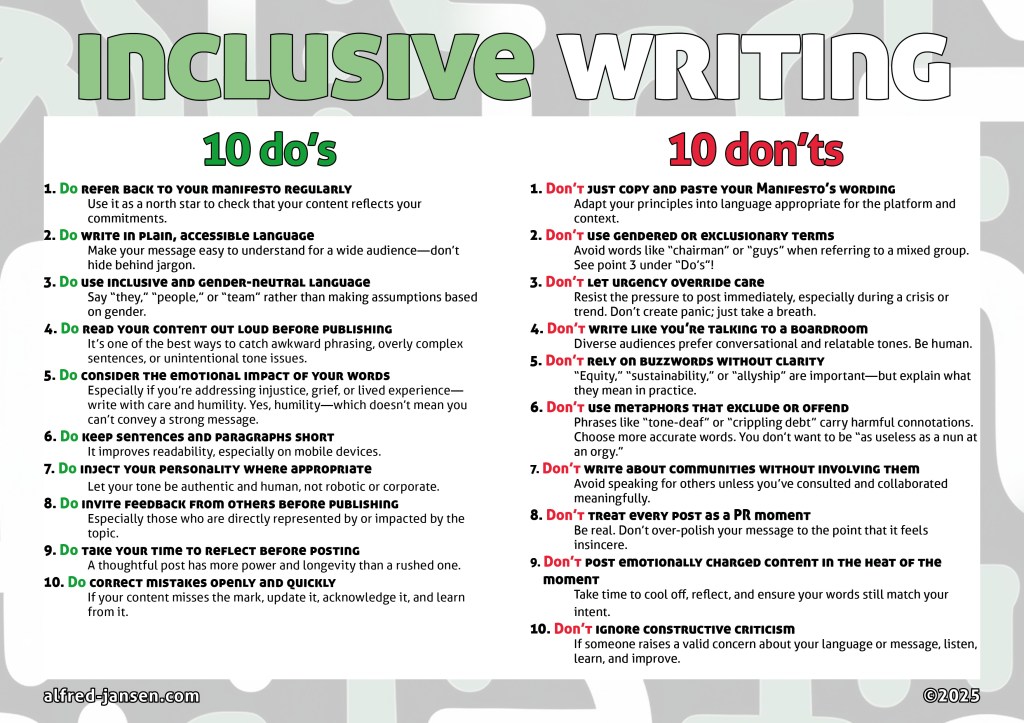
“Do’s and Don’ts” of Inclusive Writing
✅ 10 Do’s of Inclusive Writing
- Do refer back to your manifesto regularly
Use it as a north star to check that your content reflects your commitments. - Do write in plain, accessible language
Make your message easy to understand for a wide audience—don’t hide behind jargon. - Do use inclusive and gender-neutral language
Say “they,” “people,” or “team” rather than making assumptions based on gender. - Do read your content out loud before publishing
It’s one of the best ways to catch awkward phrasing, overly complex sentences, or unintentional tone issues. - Do consider the emotional impact of your words
Especially if you’re addressing injustice, grief, or lived experience—write with care and humility. Yes, humility—which doesn’t mean you can’t convey a strong message. - Do keep sentences and paragraphs short
It improves readability, especially on mobile devices. - Do inject your personality where appropriate
Let your tone be authentic and human, not robotic or corporate. - Do invite feedback from others before publishing
Especially those who are directly represented by or impacted by the topic. - Do take your time to reflect before posting
A thoughtful post has more power and longevity than a rushed one. - Do correct mistakes openly and quickly
If your content misses the mark, update it, acknowledge it, and learn from it.
❌ 10 Don’ts of Inclusive Writing
- Don’t just copy and paste your Manifesto’s wording
Adapt your principles into language appropriate for the platform and context. - Don’t use gendered or exclusionary terms
Avoid words like “chairman” or “guys” when referring to a mixed group. See point 3 under “Do’s”! - Don’t let urgency override care
Resist the pressure to post immediately, especially during a crisis or trend. Don’t create panic; just take a breath. - Don’t write like you’re talking to a boardroom
Diverse audiences prefer conversational and relatable tones. Be human. - Don’t rely on buzzwords without clarity
“Equity,” “sustainability,” or “allyship” are important—but explain what they mean in practice. - Don’t use metaphors that exclude or offend
Phrases like “tone-deaf” or “crippling debt” carry harmful connotations—choose more accurate words. You don’t want to be “as useless as a nun at an orgy.” (oooooffff) - Don’t write about communities without involving them
Avoid speaking for others unless you’ve consulted and collaborated meaningfully. - Don’t treat every post as a PR moment
Be real. Don’t over-polish your message to the point that it feels insincere. - Don’t post emotionally charged content in the heat of the moment
Take time to cool off, reflect, and ensure your words still match your intent. - Don’t ignore constructive criticism
If someone raises a valid concern about your language or message, listen, learn, and improve.
These do’s and don’ts aren’t about censoring your voice. They’re about honoring your values and making sure your message is not just seen, but felt and understood.
Add the above checklist to your process, and you’ll build trust with every word. You can download a PDF version here.
Next Post: Using AI in Inclusive Communication
I’ll tell you how to use AI responsibly and effectively when your goal is to communicate inclusively.



 alfred-jansen.com