

Welcome to my Summer Project, Bridging Visual and Verbal Communication. What can photography teach us about (Inclusive) Communication?
With a background in journalism, consumer communication, and corporate storytelling, I’ve come to see photography and communication as two sides of the same coin. Both shape how people see, feel, and respond. Whether I’m writing, designing, or taking photos, my work is always about helping people connect—with each other, with ideas, and with the world around them.
I work across the full communication spectrum—offering text, visuals, graphics, photography, and content design across digital and physical platforms. This includes real-world engagement through presentations, press events, and workshops. For me, photography isn’t separate from communication—it’s a powerful and accessible part of it.
This Summer: 10 Visual Principles for Clearer Communication
This Summer, I’m bringing these two worlds together. I’ll be exploring 10 key aspects of photography and showing how each one can be used to improve communication—especially inclusive communication. These concepts help us become more intentional, clear, and relatable when we speak, write, or create.
After this week’s Introduction, here’s what I’ll be covering the next weeks:
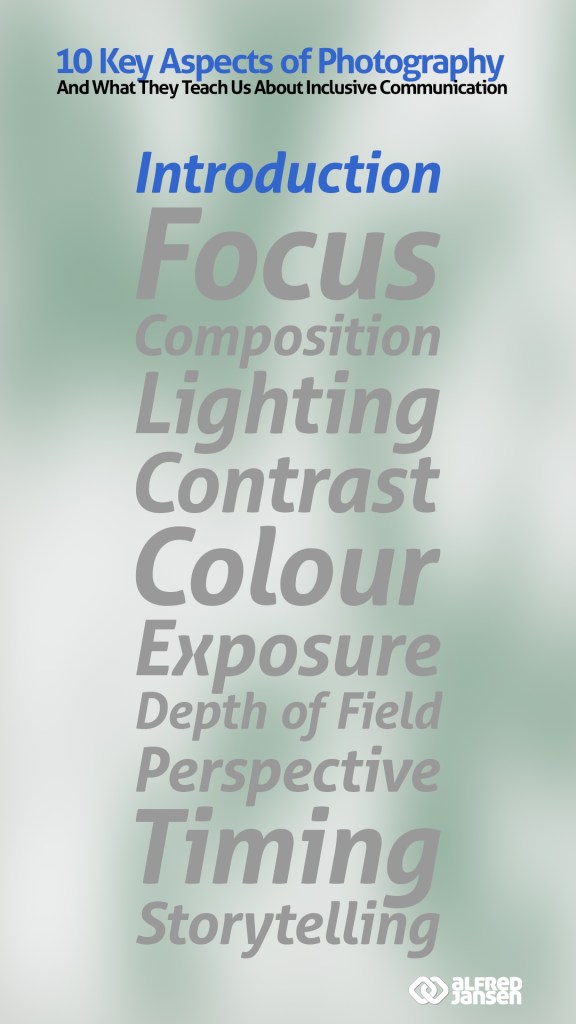
Communicating Without Words
Photography teaches us how to guide attention, evoke emotion, and share meaning—without saying a word. Concepts like focus, contrast, lighting, and composition help photographers make choices that bring clarity and feeling to an image.
These same tools are just as powerful in communication. Placing “focus” on the heart of your message helps others understand what matters. Using “contrast” makes your key points stand out. Borrowing from these visual techniques allows us to share ideas in ways that are easier to follow and more accessible to diverse audiences.
Creating Space for Everyone in the Frame
Photography also teaches us to think about how others are included—or excluded—from the frame. Perspective reminds us that there are always multiple ways to see a situation. Lighting sets the emotional tone, just like our tone of voice does in conversation. And timing can change the impact of a message entirely—whether it’s a moment of silence, a pause, or the decision to speak up.
Inclusive communication isn’t just about being clear—it’s about being aware. These visual principles help us slow down, reflect, and create space for others to be seen, heard, and valued.
Why It Matters
When we apply photography principles to how we communicate, we open up more human, empathetic, and meaningful ways of connecting. Whether you’re writing an email, leading a meeting, designing a post, or speaking at an event, thinking like a photographer helps you communicate with care and intention.
Because in the end, a good photo—and good communication—doesn’t just inform. It resonates.
Next week, I’m starting off with Focus. Literally…



 alfred-jansen.com