
Stay on Top of Your Voice and Your Values
Inclusive Communication is built on trust. Trust, especially when it comes to Diversity, Equity and Inclusion, is everything. AI changes the game. That’s why I’d like to take a look at how to (not) use AI to stay ahead of this trust game.
I recognize the tremendous value that AI brings to communication—I actively embrace it—but I approach it with deliberate care and purpose. In our distinctive Inclusive space, every word, tone, timing, and clarity plays a crucial role in building trust.
So, let’s talk about what it means to use AI in Inclusive Communication.
By now, I hope the concept of Inclusive Communication feels familiar (if not, here’s the refresher). Maybe you’ve already clarified your values, outlined your commitments, or even crafted a Manifesto that reflects what matters most to you or your organization. Great!
However important, that is just one step. Communicating clearly, consistently, and inclusively—is another. That’s where many organizations (and individuals) get stuck. And where AI tools can either help or hinder your efforts, depending on how you use them. In this post I’m going to focus on the practical part of writing inclusively. It’s my expertise.
Writing InclusiveLY
Online writing—whether it’s for your website, newsletter, LinkedIn post, or Instagram caption—demands more than just copying and pasting from your Manifesto.
Inclusive Communication means translating your values into language that real people can connect with. It’s about tone, empathy, context, and relevance. That’s not always something AI does well. But it can be guided. And it can help if you stay in the driver’s seat.
So how do you use AI to reflect inclusive values—without losing your voice or your human touch?
Guidelines for Using AI in Inclusive Writing
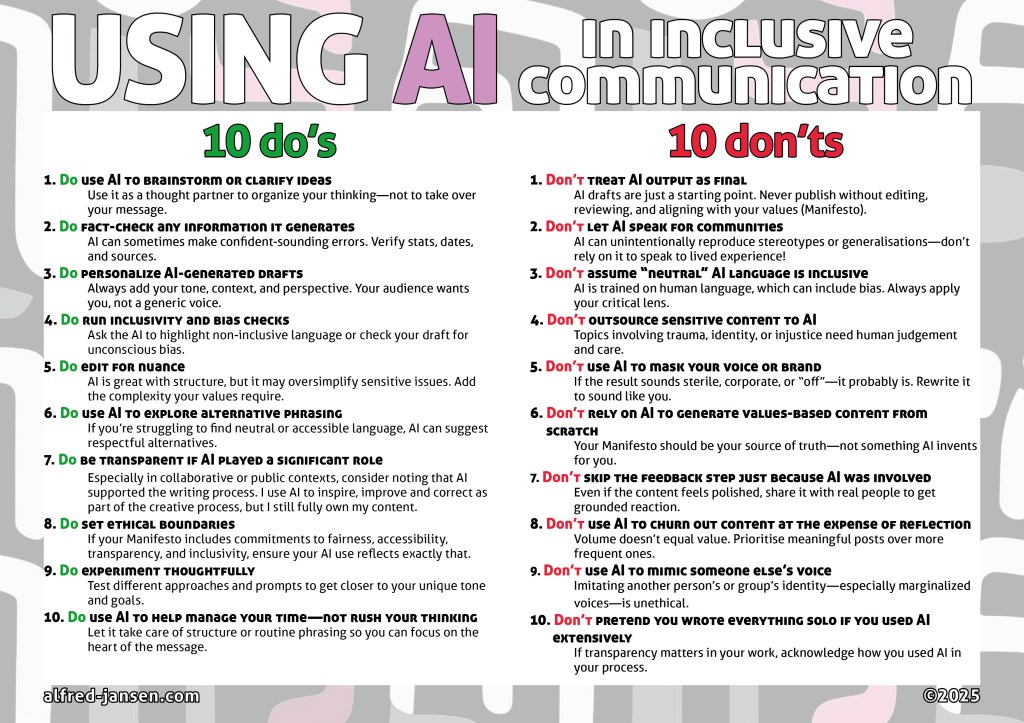
Below, you’ll find a set of “Do’s and Don’ts” for using AI tools in inclusive writing. They’re based on what I’ve learned, tried, tested, and sometimes failed at. They are especially useful for teams working in areas like HR, brand messaging, community engagement, or public affairs. And, of course, in all Diversity, Equity, and Inclusion areas. But they also help you personally.
One thing you need to remember: AI won’t replace inclusive communicators. But it can support us professionals—if we use it with purpose, reflection, and accountability.
Here’s how to use AI responsibly and effectively when your goal is to communicate inclusively.
✅ Using AI in Inclusive Communication: 10 Do’s
- Do use AI to brainstorm or clarify ideas
Use it as a thought partner to organize your thinking—not to take over your message. - Do fact-check any information it generates
AI can sometimes make confident-sounding errors. Verify stats, dates, and sources. - Do personalize AI-generated drafts
Always add your tone, context, and perspective. Your audience wants you, not a generic voice. - Do run inclusivity and bias checks
Ask the AI to highlight non-inclusive language or check your draft for unconscious bias. - Do edit for nuance
AI is great with structure, but it may oversimplify sensitive issues. Add the complexity your values require. - Do use AI to explore alternative phrasing
If you’re struggling to find neutral or accessible language, AI can suggest respectful alternatives. - Do be transparent if AI played a significant role
Especially in collaborative or public contexts, consider noting that AI supported the writing process. I use AI to inspire, improve and correct as part of the creative process, but I still fully own my content. This post is no exception. See the disclaimer at the bottom of each page on this website. - Do set ethical boundaries
If your Manifesto includes commitments to fairness, accessibility, transparency, and inclusivity, ensure your AI use reflects exactly that. - Do experiment thoughtfully
Test different approaches and prompts to get closer to your unique tone and goals. - Do use AI to help manage your time—not rush your thinking
Let it take care of structure or routine phrasing so you can focus on the heart of the message.
❌ USING AI in Inclusive Communication: 10 Don’ts
- Don’t treat AI output as final
AI drafts are just a starting point. Never publish without editing, reviewing, and aligning with your values (Manifesto). - Don’t let AI speak for communities
AI can unintentionally reproduce stereotypes or generalisations—don’t rely on it to speak to lived experience. - Don’t assume “neutral” AI language is inclusive
AI is trained on human language, which can include bias. Always apply your critical lens. - Don’t outsource sensitive content to AI
Topics involving trauma, identity, or injustice need human judgement and care. - Don’t use AI to mask your voice or brand
If the result sounds sterile, corporate, or “off”—it probably is. Rewrite it to sound like you. - Don’t rely on AI to generate values-based content from scratch
Your Manifesto should be your source of truth—not something AI invents for you. - Don’t skip the feedback step just because AI was involved
Even if the content feels polished, share it with real people to get grounded reactions. - Don’t use AI to churn out content at the expense of reflection
Volume doesn’t equal value. Prioritise meaningful posts over more frequent ones. - Don’t use AI to mimic someone else’s voice
Imitating another person’s or group’s identity—especially marginalized voices—is unethical. - Don’t pretend you wrote everything solo if you used AI extensively
If transparency matters in your work, acknowledge how you used AI in your process.
Used well, AI can enhance your clarity, creativity, and consistency. But remember: you are the heart of your message, and you should stay at its very heart. Stay grounded in your Manifesto, edit with intention, and let AI be a tool—not a shortcut—for writing that truly reflects you. Read more about Inclusive Writing here.
Feel free to add these do’s and don’ts to your process, if you think it will help you! You can download the PDF version here.



 alfred-jansen.com